You're burning out faster because of AI, not despite it

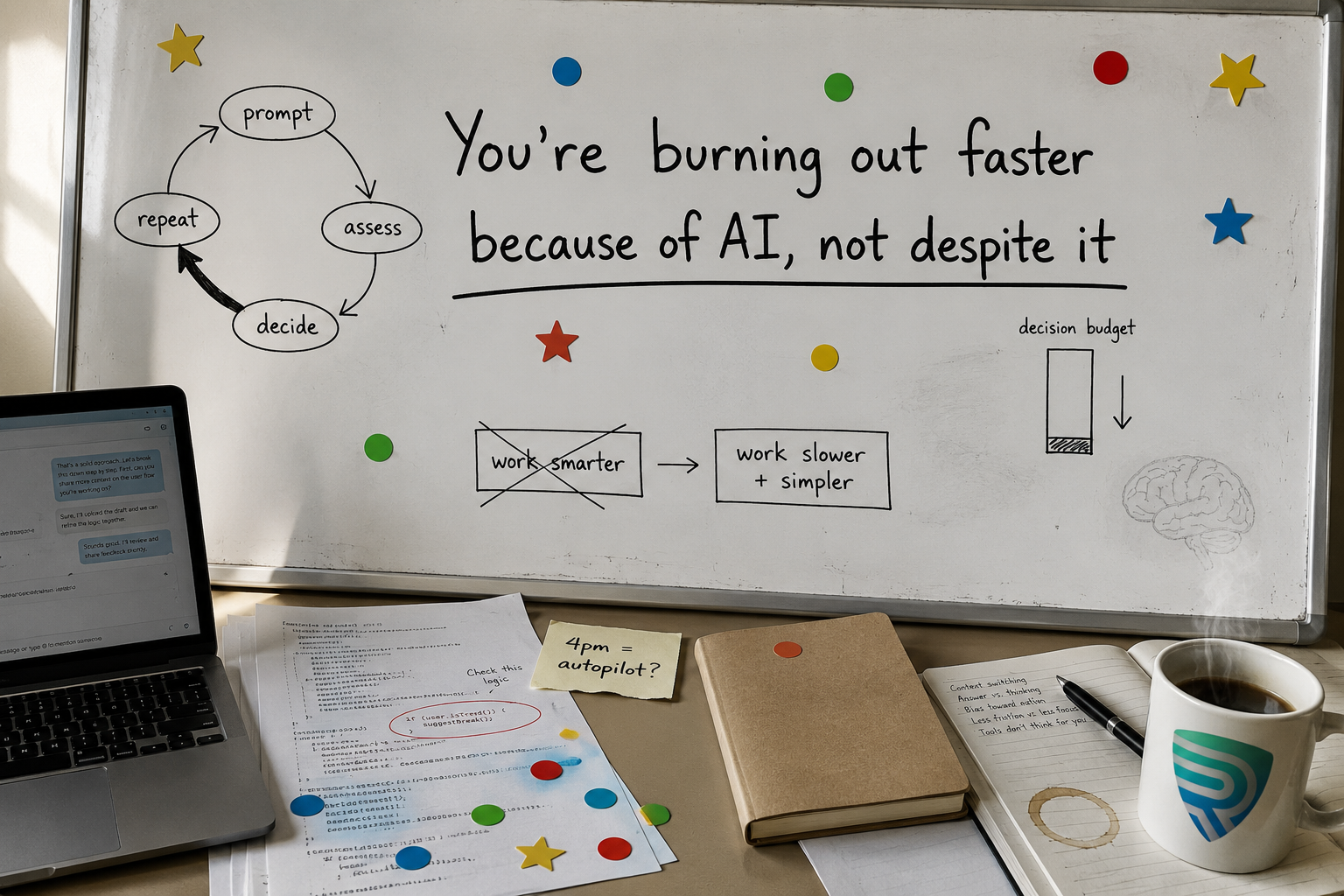
Everyone's noticed that AI tools are fast. What fewer people have noticed is that they're also quietly exhausting in a way the work never was before.
This isn't about eye strain or bad posture. It's about what happens inside your prefrontal cortex after a day of prompt-driven work, and why the rest you're not getting between prompts might matter more than whatever you're shipping.
Your brain runs on a limited budget
Decision-making is expensive. The prefrontal cortex, the part of your brain responsible for planning, judgment, and weighing options, is the first region to struggle when your brain gets overtaxed.
For a long time, researchers thought this happened because the brain was running low on glucose. That's still partly true: the brain uses roughly 20% of the body's glucose supply, and the prefrontal cortex is unusually sensitive to dips in that supply. But a 2022 study published in Current Biology pointed to something more specific.
After a day of cognitively demanding work, researchers measured higher concentrations of glutamate, a primary excitatory neurotransmitter, in the lateral prefrontal cortex. The group doing harder cognitive work had glutamate levels about 8% higher than the easier-task group, and made roughly 10% more impulsive decisions as a result. The brain wasn't running out of fuel so much as becoming saturated with a metabolic byproduct of its own activity. The more decisions it had to process, the harder it became to process them well.
Dopamine and noradrenaline also take a hit during sustained decision-making. Both are involved in motivation and cognitive control. When they deplete, the pull toward the easiest option, or no option at all, gets stronger. Pure physiology, not a character issue.
There's also the cortisol angle. Short bursts of pressure can sharpen focus. Prolonged exposure does the opposite, degrading exactly the prefrontal functions you need for good technical judgment.
None of this is new. Judges make harsher decisions late in the day. Surgeons make more errors toward the end of long shifts. Decision fatigue has been documented across medicine, law, and finance for years.
What's new is what vibe coding does to the timeline.
Traditional programming had a natural pace
In traditional programming, decisions are still there, lots of them, but they're spread out. You type. You read documentation. You search Stack Overflow, wait for a build, walk to make coffee. The architecture decisions are interspersed with long stretches of mechanical work that don't drain the same resource.
Vibe coding compresses all of that.
You write a prompt, get code back in seconds, assess it, decide whether it's right, decide what to fix, write another prompt. Repeat. The loop is tight. There's almost no filler. Every step requires active judgment: is this output correct? Does it match the spec? What's the right way to phrase the next prompt? Is this edge case handled?
The waiting period, while the model generates, might look like rest. In practice, most people use it to check something else. Another project. A Slack message. A quick question from a colleague. Which brings in the second problem.
Context switching compounds it
Running three to five projects in parallel is increasingly common for developers who use AI tools. The output is higher, so the expectation is higher, so more gets taken on.
Research by psychologist David Meyer, cited by the American Psychological Association, found that the mental blocks created by switching between tasks can consume up to 40% of someone's productive time in a day. A University of California, Irvine study found it takes an average of 23 minutes to fully refocus after an interruption. Each switch also burns a slice of the same cognitive budget that decision-making draws from.
The waiting-and-switching pattern of vibe coding, where you fire off a prompt and immediately pivot to something else, means your brain is never actually recovering. The prefrontal cortex doesn't get a break, it just changes subject.
The numbers back it up
A 2025 study by Feng et al., accepted at ICSE 2026, surveyed 442 developers across different organisations, roles, and experience levels. GenAI adoption heightened burnout by increasing job demands, with workload as the strongest predictor. Developers described feeling like their brains were running at 100mph when the sustainable cruising speed was closer to 60. One participant compared it to using a fuel additive that boosts engine performance beyond what the manufacturer recommends. It works, until it doesn't.
It's not just developers
Vibe coding gets the attention because the output is measurable and the tooling is visible. But the same cognitive pattern plays out across any AI-assisted knowledge work, and in some fields it's worse.
Take marketing. A campaign manager using AI today might generate ten copy variations before breakfast, review AI-produced ad creatives, brief an image model, check performance data, tweak a prompt, rerun it, assess the new output, decide which version to test. Each of those steps is a decision. None of them feel hard. All of them draw from the same prefrontal budget.
The difference from coding is that marketing has even fewer natural forcing functions. A developer at least has a build to run, a test suite to wait on. A marketer with AI tools can sustain the decision loop almost indefinitely. There's always another variation to try, another subject line to test, another audience segment to brief the model on.
The same pattern shows up in legal work, where AI drafts contracts that still require clause-by-clause review. In recruiting, where AI screens candidates but a human still reads fifty summaries and makes calls. In finance, where AI surfaces anomalies that someone has to assess and act on. The AI removes the mechanical parts of the job and leaves mostly judgment. Back to back, all day, with no filler in between.
The prefrontal cortex doesn't know what industry you're in. It just knows how many decisions it's had to make.
The problem with feeling fine
Back pain from a bad chair is obvious. Carpal tunnel has a clear cause-and-effect. Cognitive depletion from an AI-assisted workflow is subtle because the work feels easier moment to moment. Prompting is less effortful than typing. Waiting feels like a break. You're shipping more than ever. You feel sharp.
But the subjective experience of effort isn't a reliable measure of cognitive cost. The glutamate study measured objective brain chemistry, not how participants felt. Neither prompting nor waiting maps accurately to what the prefrontal cortex is actually doing during those actions. The depletion is happening underneath the feeling of performance, which is exactly what makes it hard to catch before it catches you.
A few things that actually help
When the model is generating, actually rest. Get up. Look out a window. Ninety seconds of doing nothing is the difference between running glutamate high all afternoon and giving it a chance to clear. It sounds too simple to matter. It isn't.
Time-box your AI-assisted sessions the same way you'd time-box any deep work. Decision fatigue accumulates across the day, so front-load your most complex architectural calls to the morning when the budget is full.
Be honest about how many parallel projects you're carrying. The AI increased your throughput. It didn't increase your brain's decision-making capacity. Spreading the same budget across five things doesn't make it go further.
If you're approving AI output on autopilot by 4pm, you've already been overdrawn for a while. That's when to stop, not push through.
The productivity gains from AI-assisted development are real. So is the cost. The difference is that one of them shows up in your commit history and the other shows up six months later when you can't figure out why you're exhausted by Wednesday.